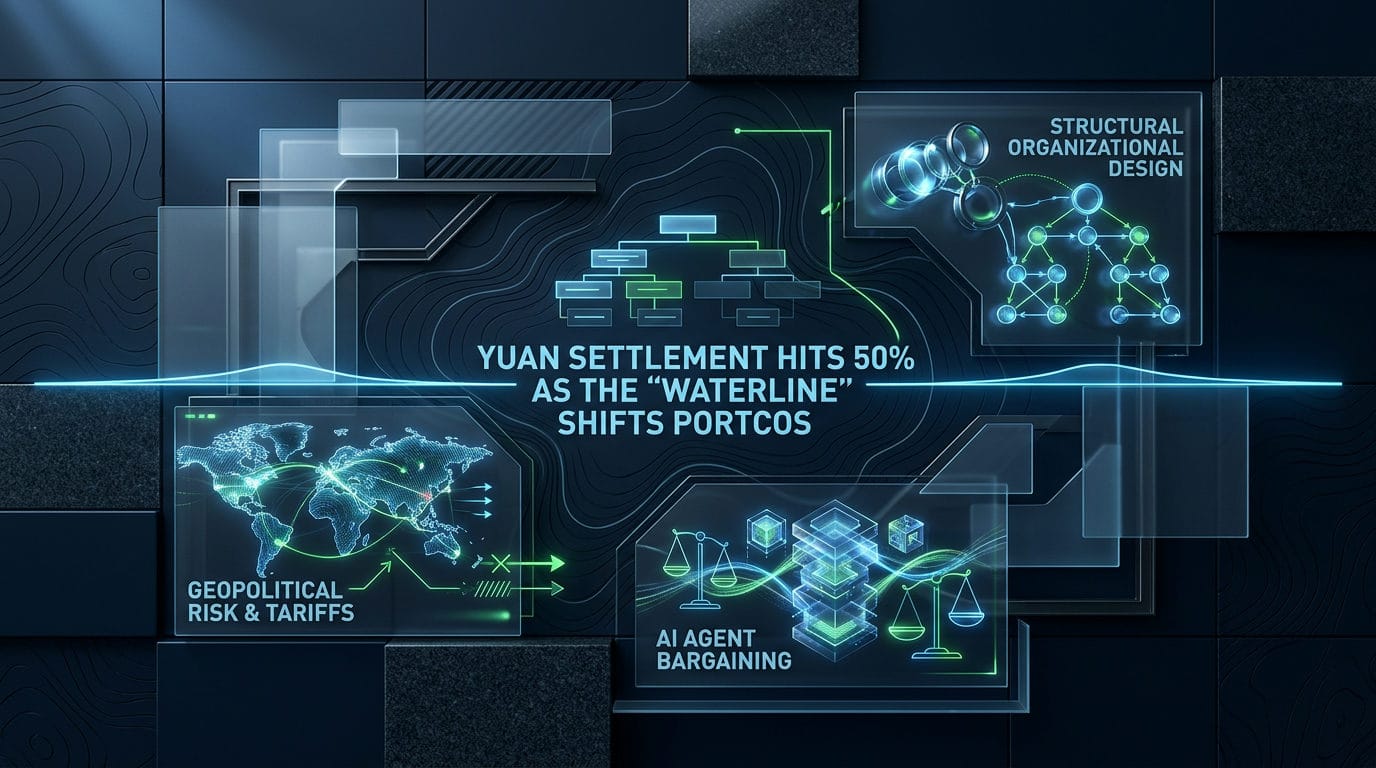
Direct confrontation and structural clarity are the new prerequisites for resilience in a fragmented, high-friction global economy.
📊 10 episodes across 9 podcasts
⏱ 7 hours 41 minutes of intelligence analyzed
🎙 Featuring: George Couros, Jim Vaselopulos, Jan Rutherford, Scott Galloway, Ethan Mollick, Michael Camuñez, Christina Wing, Molly Graham
|
The Structural Myth of the Underperformer
For leaders facing team friction or stagnant growth, the instinct is often to look for the "who"—which individual is failing to meet the moment? But the intelligence gathered this week suggests that individual performance is a lagging indicator of structural health. Strategy without structural clarity is merely a hope, and most "performance issues" are actually symptoms of misaligned authority or decision rights.
The "Waterline" Diagnostic: Molly Graham (Worklife) introduces the 🆕 Waterline Model, a framework that forces leaders to stop blaming people for systemic failures. The thesis is simple: 90% of managers fail because they address interpersonal drama before fixing structural ambiguity. If two successive hires fail in the same role, the problem isn't the talent; it’s the role design. Similarly, Ethan Mollick (Wharton) notes that AI adoption is currently hitting a "jagged frontier" not because of tech limitations, but because organizational redesign hasn't happened yet.
"The job of a manager is to create the conditions that give people the highest possible chance of success. It is not to make people successful, it is to create the conditions."
— Molly Graham, Host of Worklife with Adam Grant
Why it matters: As geopolitical fragmentation (Dr. Lori Esposito Murray) and AI-driven automation (Ethan Mollick) increase the complexity of the business environment, boards and CEOs must resist the urge to over-specialize their talent. Instead, the priority must be on Radical Candor (Kim Scott) and the courage to dissent (Michael Camuñez). High-functioning teams in this cycle won't be defined by their technical specialization, but by their ability to navigate 🆕 taboo topics and clear the "waterline" of structural dysfunction.
Board Question: Have we diagnosed the structural authority gaps in our leadership team before we attribute this quarter's misses to individual performance?
IDEAS IN BRIEF
① Geopolitical Risk is No Longer an "International" Problem.
Michael Camuñez argued that even domestic-focused companies are now exposed to global shifts in commodity pricing and supply-chain renegotiation. (Michael Camuñez on Boardroom Governance)
→ The Implication: Boards should avoid the trap of "single-subject" directors (e.g., a "Cyber Director" or "China Director") and instead build enterprise-wide risk capabilities across the full board.
② Ownership Beats Buy-in for Durable Change.
Securing collective ownership of a vision, even if it results in a 90% version of the original plan, is superior to a perfect vision that lacks stakeholder fingerprints. (George Couros on The Leadership Podcast)
→ The Opportunity: Involving skeptics early in the learning process—rather than just the outcome—converts critics into advocates for contentious innovations like AI.
③ The Rise of Agent-to-Agent Bargaining.
Ethan Mollick predicted that consumer AI agents will soon handle routine negotiations, such as bank account switching or customer service disputes, making human friction nearly costless to bypass. (Ethan Mollick on The Prof G Pod)
④ Optimization is a Sophisticated Form of Procrastination.
Oliver Burkeman noted that "[productivity systems] can be a sophisticated way of postponing the difficult first step." (Oliver Burkeman on The Prof G Pod)
→ The Implication: Leaders should pivot toward "dailyish" consistency and closed task lists to avoid the trap of chasing a "perfected future self" that never arrives.
⑤ Tariffs are Now a Permanent Revenue Instrument.
Dr. Lori Esposito Murray noted that 🆕 US tariffs are likely to persist regardless of election outcomes because they provide unilateral policy leverage and revenue against national debt. (Dr. Lori Esposito Murray on C-Suite Perspectives)
→ The Strategist's Read: Supply chain managers must treat protectionism as a structural certainty rather than a temporary political cycle.
SIGNAL BOARD
🔥 HEATING UP
• Yuan Settlement: China now settles >50% of cross-border receipts in its own currency, up from <1% in 2010. (Dr. Lori Esposito Murray on C-Suite Perspectives)
• Hybrid Exits: Minority recapitalizations and staged liquidity are replacing the "all-or-nothing" full sale model for founders. (Gwen Griggs on CEO School)
• Active Learning: AI is forcing universities to move toward in-class assessment and human-centric tutoring. (Ethan Mollick on The Prof G Pod)
👀 ON WATCH
• 🆕 Waterline Model: A diagnostic tool prioritizing structure and dynamics over individual performance metrics. (Molly Graham on Worklife)
• 🆕 Personal AI Agents: New tools like Perplexity and Claude are transitioning from information retrieval to active agency. (Ethan Mollick on The Prof G Pod)
• 🆕 Taboo Transparency: Radical openness about family wealth and money is being framed as a tool for relationship resilience. (Christina Wing on Radical Candor)
❄️ COOLING OFF
• Dating Algorithms: Malcolm Gladwell noted that personality questionnaires fail to predict chemistry better than a "random walk." (Adam Grant on ReThinking)
• LGBTQ Disclosure: Declining corporate disclosure is making board representation harder to track, even if appointments continue. (Michael Camuñez on Boardroom Governance)
• Unbroken Habits: The shift from "streaks" to "dailyish" consistency as a more durable productivity framework. (Oliver Burkeman on The Prof G Pod)
THE TENSION
Should AI adoption be driven by technical capability or prior personal values?
🔵 Perspective One: Ethan Mollick argues that the "jagged frontier" of AI is expanding so rapidly—with 180 models already outperforming GPT-4—that workers and junior talent are already vulnerable. Failure to adapt to the technical reality now will result in immediate obsolescence for junior-heavy roles.
🔴 Perspective Two: Oliver Burkeman contends that the psychological pressure to "keep up" with LLMs is a trap. He argues AI should remain subordinate to personal values, warning that organizing one's life around technical capacity leads to a loss of agency and intrinsic motivation.
The Strategist's Read: The tension resolves in structural redesign; AI will not replace the worker, but the organization that uses AI to augment human "taste and agency" will inevitably replace the one that uses it merely for efficiency.
THE BOTTOM LINE
Performance is a systemic output; stop fixing your people and start fixing the structural ambiguity that makes them fail.
APPENDIX
BoardVision: "Crisis Leadership Lessons for Boards" · 30 min · Featuring Vincent Brooks ▶ Listen · Apple Podcasts
The Value: Essential for directors building 40/70 decision frameworks to act during information-sphere crises.
Boardroom Governance: "Michael Camuñez: Geopolitics, Board Independence, and the Courage to Dissent" · 61 min · Featuring Michael Camuñez ▶ Listen · Apple Podcasts
The Value: A masterclass in how demographic diversity and lived experience function as vital risk-mitigation tools.
C-Suite Perspectives: "Why Tariffs and Protectionism Are Here to Stay" · 28 min · Featuring Dr. Lori Esposito Murray ▶ Listen · Apple Podcasts
The Value: Provides a sobering look at the end of Pax Americana and the rise of currency fragmentation.
CEO School: "CEO Week Live Panel A: Exits, Valuations, and All Things MONEY" · 51 min · Featuring Suneera Madhani ▶ Listen · Apple Podcasts
The Value: Critical for founders to understand that after-tax proceeds matter more than headline "unicorn" valuations.
Radical Candor: "How can you confront a bullying boss without losing your job?" · 44 min · Featuring Christina Wing ▶ Listen · Apple Podcasts
The Value: A guide to high-stakes communication and why "difficult conversations" are the antidote to "difficult moments."
ReThinking: "The psychology of compatibility with Malcolm Gladwell" · 61 min · Featuring Malcolm Gladwell ▶ Listen · Apple Podcasts
The Value: Explores the limitations of algorithms in predicting human chemistry and the value of shared experiences.
The Leadership Podcast: "TLP534: What If You're Wrong? | George Couros" · 48 min · Featuring George Couros ▶ Listen · Apple Podcasts
The Value: Frames innovation as a process of emotional connection rather than just data-driven mandates.
The Prof G Pod: "Can We Coexist With AI? — with Ethan Mollick" · 60 min · Featuring Ethan Mollick ▶ Listen · Apple Podcasts
The Value: The most tactical update on current LLM capabilities and the emerging threat to junior-level labor.
The Prof G Pod: "Why Optimization Culture Is Making You Miserable" · 50 min · Featuring Oliver Burkeman ▶ Listen · Apple Podcasts
The Value: A necessary corrective for high-performers prone to burnout and metric-driven anxiety.
Worklife with Adam Grant: "Diagnose your team’s problems with the Waterline Model" · 28 min · Featuring Molly Graham ▶ Listen · Apple Podcasts
The Value: Provides a 4-layer diagnostic framework for any leader dealing with team friction or underperformance.